

Mathew Knowles at WMF: From the Data Behind Beyoncé’s Success to AI: 'Don’t Be Afraid of Change'
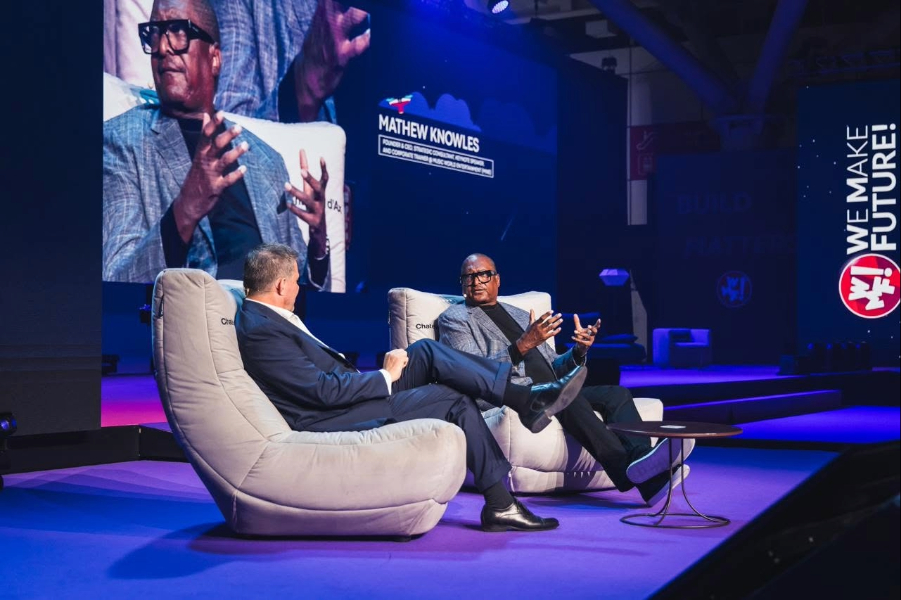
Mathew Knowles on Mainstage!
At WMF 2026, Mathew Knowles and Carlo Durante (Billboard) delivered a masterclass on the future of music, exploring fan economics, AI, and IP management.
BOLOGNA, BOLOGNA, ITALY, June 30, 2026 /EINPresswire.com/ -- One of the most influential strategists in the global music industry - and the executive behind the success of Destiny’s Child and Beyoncé - took the Mainstage at WMF – We Make Future 2026, the International Trade Fair and Festival on Artificial Intelligence, Technology, and Digital Innovation, to discuss how successful music brands are built, scaled, and protected in the age of artificial intelligence.Mathew Knowles, Founder and CEO of Music World Entertainment (MWE), global business strategist, keynote speaker, and executive coach, joined Carlo Durante, CEO of Billboard Italia, for a wide-ranging conversation that evolved into a masterclass on music, business, technology, and long-term strategic vision.
Knowles brought to WMF a global perspective on how the music industry has continuously reinvented itself—from cassette tapes to CDs, from streaming to AI, from record catalogs to the emerging superfan economy. His central message was clear: long-term artistic success is built not only on talent, but also on strategy, data, partnerships, intellectual property, and the ability to anticipate industry shifts before they happen.
Reflecting on his transition from the technology sector into the music business, Knowles explained how his background shaped the management philosophy behind Destiny’s Child. Long before social media and streaming platforms transformed the industry, the group's growth strategy was already driven by consumer insights, data analysis, strategic partnerships, and scalable business models—an approach that now seems remarkably forward-looking.
During the conversation, Knowles described how Destiny’s Child evolved into far more than a successful music act. Starting with limited financial resources, the brand expanded through strategic commercial partnerships with major international companies, creating an ecosystem that amplified its visibility, market reach, and long-term value. One of the most relevant themes of the discussion focused on the relationship between artists and their audiences. According to Knowles, music cannot exist without fans. Today's challenge is no longer simply reaching the largest possible audience, but cultivating loyal communities through meaningful engagement and exclusive experiences. This, he explained, is the foundation of the emerging superfan economy, where a relatively small but highly engaged audience can generate a significant share of an artist's long-term economic value.
Artificial intelligence was another key topic. Rather than viewing AI as a threat, Knowles encouraged the audience to see it as a transformative opportunity capable of enhancing creative, operational, and administrative processes. From tour planning and stage visualization to wardrobe design, choreography, logistics, and production, AI is already opening new possibilities for artists, managers, and the broader creative industries.
“The music industry is like a moving target,” Knowles said, emphasizing the constantly evolving and increasingly global nature of the business. In this environment, he argued, ownership and control of intellectual property become even more critical. Those who understand the strategic value of rights, licensing, catalogs, and algorithms are better positioned to build resilient, scalable, and sustainable business models. Knowles also reflected on Destiny’s Child as an example of long-term brand management. Rather than treating the group as a standalone musical project, it was conceived as a platform capable of generating solo careers, expanding intellectual property, creating new narratives, and unlocking multiple revenue streams over time. While this vision was not universally understood at the outset, it has since become a powerful example of building brands designed for lasting impact.
Closing the session, Knowles left the WMF audience with a message about resilience in times of technological disruption and uncertainty: “Don't pray for a life free of trouble; pray for joy in the midst of trouble.” Challenges, he explained, should neither be avoided nor feared—they are often where the greatest opportunities emerge.
From the WMF Mainstage, Mathew Knowles delivered a compelling lesson in vision, leadership, and adaptability. In the music industry, as in every sector shaped by technological innovation, change should not simply be endured. It should be understood, embraced, and transformed into long-term value through data, intellectual property, strong communities, artificial intelligence, and the confidence to look beyond the next disruption.
WMF – We Make Future is conceived, produced, and organized by Search On Media Group. The event is held under the patronage of the European Parliament, the European Commission, the Italian Ministry of Foreign Affairs and International Cooperation (MAECI), the Emilia-Romagna Region, and the City of Bologna. WMF is supported by the Italian Ministry of Foreign Affairs and International Cooperation (MAECI), the Italian Trade Agency (ITA), and the Emilia-Romagna Region, in partnership with Visit Emilia-Romagna, and in collaboration with BolognaFiere, CINECA, and the European Space Agency (ESA). The 2026 Main Sponsors are Philip Morris, and Dell Technologies and Intel.
Press Office
Search On Media Group
+39 051 095 1294
press@wemakefuture.it
Legal Disclaimer:
EIN Presswire provides this news content "as is" without warranty of any kind. We do not accept any responsibility or liability for the accuracy, content, images, videos, licenses, completeness, legality, or reliability of the information contained in this article. If you have any complaints or copyright issues related to this article, kindly contact the author above.
